
Study games for ADHD and autism
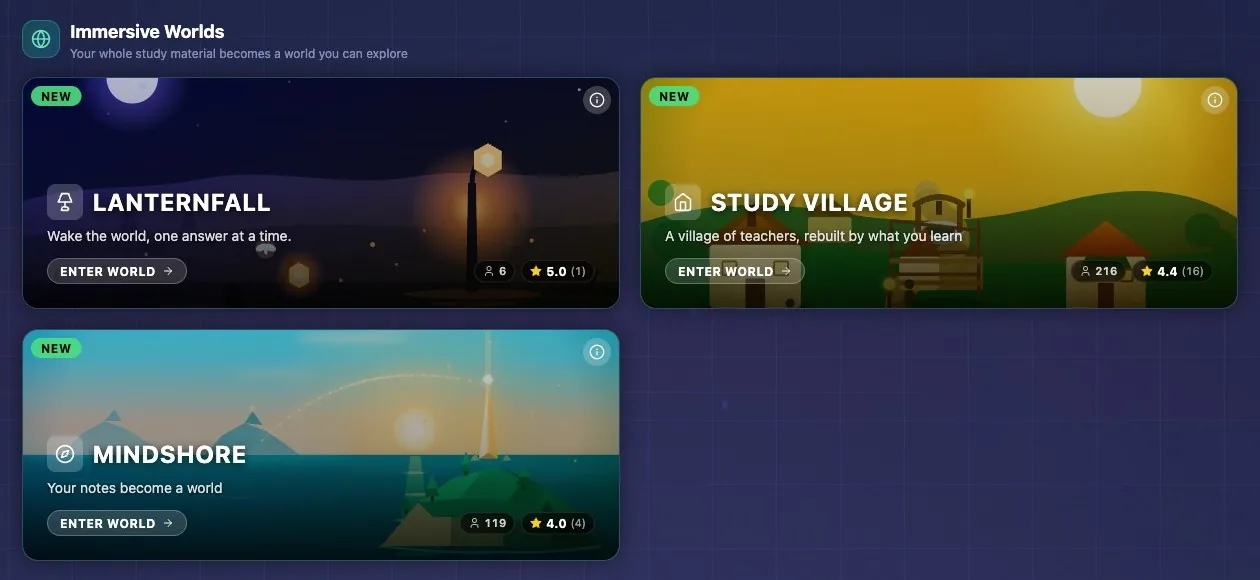
Some students can sit down with a highlighter and get through a chapter. Plenty can't, and it has nothing to do with how smart they are. If you have ADHD, autism, or dyslexia, or you're helping someone who does, you already know that "just remove distractions" doesn't get the reading done. This guide covers what game-based studying actually offers, and takes a close look at StudyQuest's Immersive Worlds, which rebuild the game world itself out of your study material. We haven't found another study tool that does that.
Why games help when focus is the hard part
A textbook page gives you nothing back. You can read it for ten minutes or drift off after two, and the page reacts exactly the same way. For a brain that runs on interest and immediate feedback, which is a fair description of many ADHD brains, that silence is brutal. The work isn't too hard. It's too quiet.
A game answers back every few seconds. You pick an answer and something happens: a villager cheers, land turns green, a lantern lights. That loop of act, see result, act again is the same thing that makes video games so absorbing, pointed at your coursework. And under the game layer sits active recall, the one revision technique with decades of evidence behind it. A game won't let you progress without answering, so you end up doing far more retrieval than you would re-reading. Our exam prep guide goes deeper on why recall beats re-reading for everyone.
The research on gamified learning for neurodivergent students is promising rather than settled. Reviews of studies on ADHD learners keep landing on the same finding: the clearest gains are in engagement and motivation, with attention and academic performance improving in some trials, including a recent randomised controlled trial of a gamified learning app for children with ADHD. No study calls games a fix. They make practice happen, and practice is the thing that was not happening.
That's the honest pitch: the best study method is the one that actually happens.
Immersive Worlds: your notes become the game
Most learning games, including most of StudyQuest's own forty-plus modes, take one question at a time and wrap play around it. The Immersive Worlds go further: the app reads your whole upload and generates the entire world from it. The place names, the characters, what each character teaches, the questions they ask, all of it comes from your material.
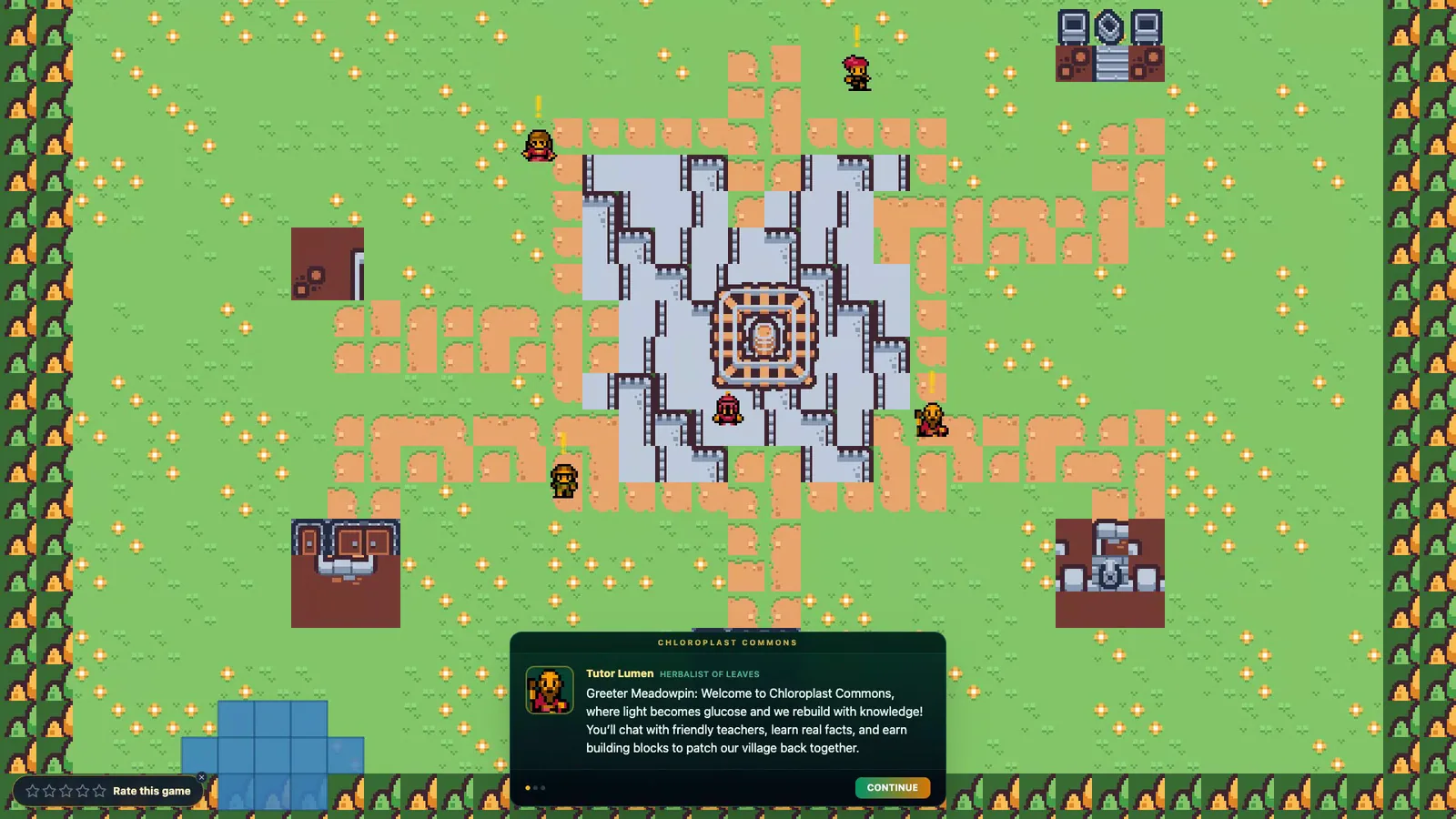
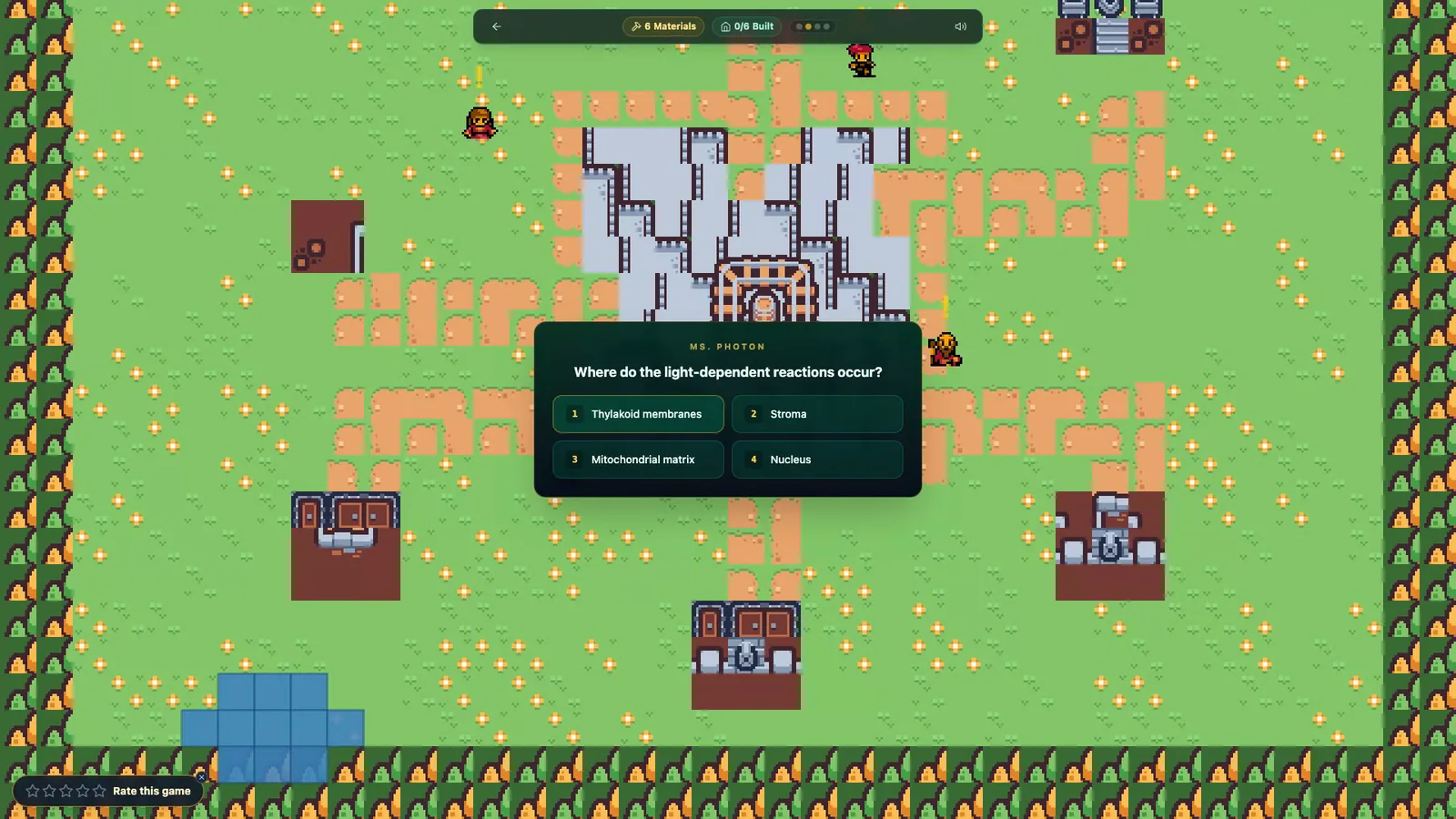
Feed it photosynthesis notes and the village that appears calls itself Chloroplast Commons, greets you through a "Herbalist of Leaves," and staffs itself with teachers like Ms. Photon, who quizzes you on the light-dependent reactions. A history chapter would produce a different town with different residents. The first time I watched it name the village after the notes, I grinned. It's a small touch that changes whose world it is: the game is set inside the thing you're trying to learn.
Study Village
A cosy pixel-art town where every villager owns one slice of your material. You walk up, they teach it in a few short pages, then ask you about it. Right answers earn building materials you spend repairing the village's six broken structures, from the well to the town hall, and when the last one goes up the villagers throw a festival. Miss a question and the villager re-explains the exact point you got wrong, in character, before letting you try again. Nothing you miss gets marked and forgotten.
Mindshore
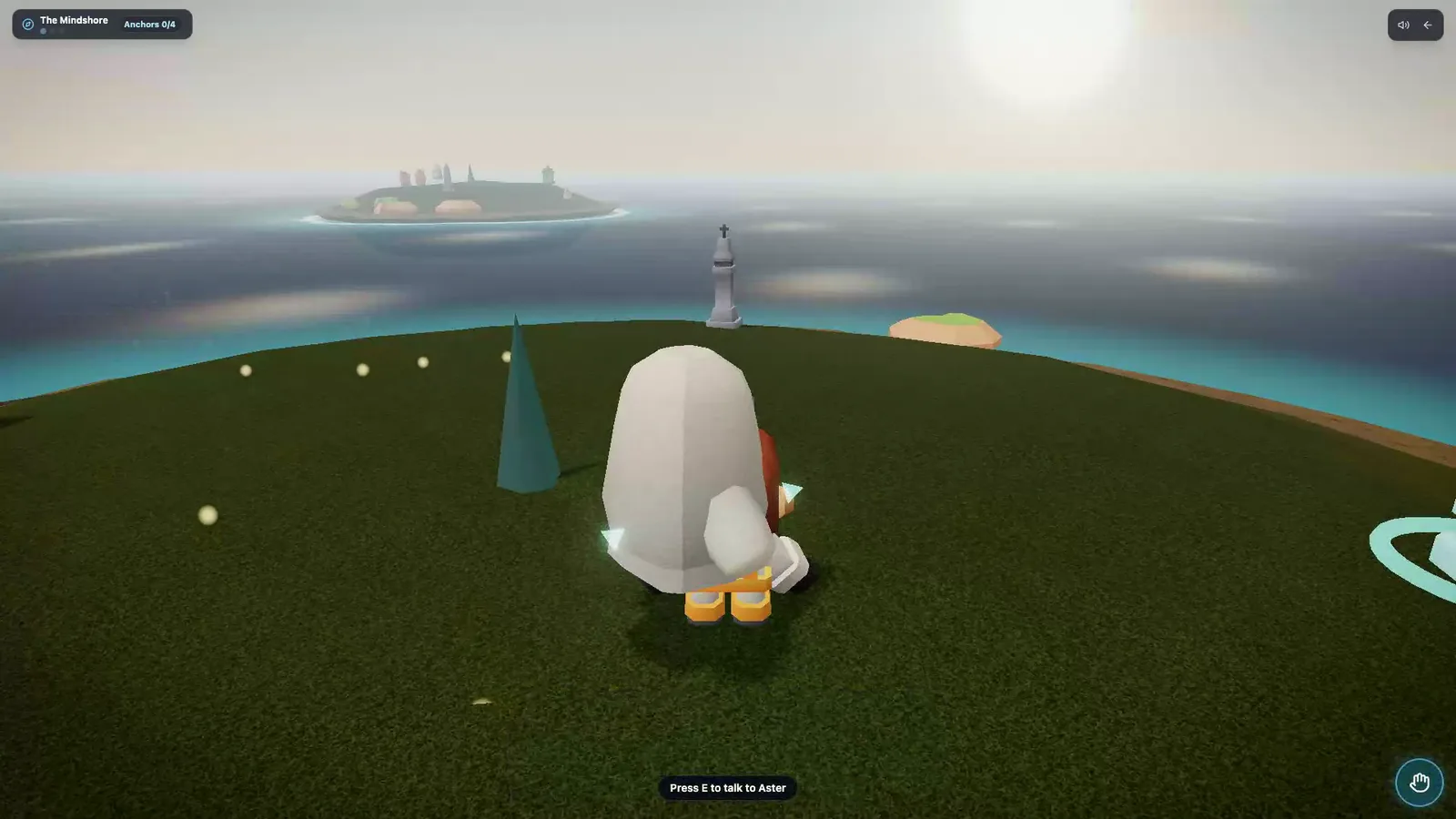
A quiet 3D archipelago with one island per concept. A guardian spirit teaches the idea, then sends you out to landmarks where questions wait. Every question comes with a mnemonic that welds the fact to the spot you're standing on, which is the ancient memory palace technique doing modern homework. Answer right and the ground blooms green under your feet. Leave an island alone too long and mist creeps back over it, on a real forgetting curve, and the game invites you back for a short memory walk. That's spaced repetition without a schedule to manage.
Lanternfall
A story voyage through a world that fell asleep when its lanterns went out. You sail the old lantern route with Glim the star-moth, and every right answer lights a lantern and visibly wakes something: forests glow, the aurora returns. Wrong answers are never punished. They become wisps that drift behind your boat until you free them with another try. There are no timers and no game over, just three chapters that end in a sunrise.
All three worlds are free to enter, they teach before they quiz, and they run in the same language as your notes. Everything below builds on them, because the things that usually break a study session for a neurodivergent student are the things these worlds were built without.
What helps students with ADHD
ADHD rarely means a lack of attention. It means attention that goes where the stimulation is, plus real difficulty with starting, switching, and keeping track. A few things in StudyQuest line up with that directly.
- Feedback lands in seconds, not at marking time. Every answer changes the world immediately. For a brain that discounts distant rewards, "the bakery gets rebuilt right now" is worth more than "this will help in June."
- Progress is visible and external. Materials earned, buildings repaired, anchors lit, XP, a daily streak. You never have to hold your progress in your head, which is exactly the kind of tracking executive function struggles to do internally.
- Mistakes don't end the run. In the worlds, a wrong answer turns into another explanation or a wisp you can still free. Removing the fail state removes the rage-quit moment, and with it the shame spiral that ends so many revision sessions.
- The app decides what to review. Mindshore's islands mist over as memories fade and pull you back for a short walk. Planning a spaced repetition schedule is executive work; here the world does it for you.
- Short sessions are built in. There's a focus timer in the navigation bar with work and break presets, and finished sessions earn XP. One villager or one island is a natural, honest stopping point.
A realistic expectation: a game lowers the cost of starting, and starting is most of the battle. It doesn't make a tired brain less tired. Twenty minutes in a world beats a two-hour plan that never survives contact with the sofa.
What helps autistic students
For autistic students the research points less at rewards and more at structure: predictable routines and clear expectations do more for learning than any amount of novelty. The worlds are structured in a way a classroom rarely manages to be.
- Every interaction follows the same script. Walk to a character, choose to talk, read the lesson, answer, get thanked. The loop never changes shape mid-session. You always know what happens next.
- You start every conversation. Nothing ambushes you. Characters wait until you press a key or tap them, so the pace of the session is entirely yours.
- The characters are kind by design. The generation rules that build each world explicitly forbid mockery. A wrong answer gets a patient re-explanation, not a buzzer.
- No countdowns, and sound is optional. The worlds are paced for exploring, Lanternfall has no timers at all, audio can be muted, and the app respects your device's reduced-motion setting.
- Special interests become the curriculum. This is the quiet superpower. Upload pages about the thing they already love, trains, mythology, marine biology, and the world themes itself around it. Building lessons on a student's deep interest is one of the best-documented ways to engage autistic learners, and here it takes one upload.
The worlds are also single player. There's no leaderboard of classmates, nobody watching you answer, and no social performance layered on top of the studying. StudyQuest has multiplayer modes for students who want them, but the worlds themselves are a private place.
Dyslexia and other reading differences
A student with dyslexia doesn't need less content. They need it in pieces that don't exhaust the decoding budget before the meaning arrives. The worlds help here mostly through structure.
- Short pages, one idea at a time. A villager's lesson comes in a few small pages you advance at your own speed, not a scrolling wall of text. Questions appear one at a time.
- Photograph the material instead of retyping it. StudyQuest accepts photos and screenshots and reads the text out of them, along with PDFs, Word and PowerPoint files, or pasted text. Retyping a chapter is a real barrier when writing is the hard part. See how to turn notes into games for the full input options.
- Spelling doesn't fail you. Most questions are multiple choice, and where typed answers exist they accept close spellings and synonyms. Knowing the fact counts; spelling it perfectly doesn't.
- Facts get pictures attached. Mindshore ties every fact to a vivid image at a physical landmark. Memory built on images and places leans on strengths many dyslexic students already have.
Two honest gaps: there's no built-in text-to-speech and no dyslexia font setting. If read-aloud matters, the screen reader built into your phone or computer works on top of the app, and meta-analyses of read-aloud tools show a real comprehension benefit for students with reading disabilities, so it's a combination worth setting up.
A calm setup that sticks
The tool matters less than the routine around it. This one is boring on purpose.
- Get the material in the easiest way available. Photograph the chapter, upload the PDF, or paste the text. Friction here kills the whole thing, so pick whichever takes under a minute.
- Make one world visit the unit of studying. Not "study for an hour." Visit two villagers, or clear one island. A session with a shape you can picture is a session that starts.
- Use the focus timer if time slips. Start a work preset when you enter the world and stop at the break. Time blindness is real; borrowing the app's clock costs nothing.
- Let the mist choose the review day. When Mindshore says an island has fogged over, that's the day's task, already picked. Review scheduling is the part students most often abandon, so hand it over.
- Treat the streak as optional. Streaks motivate some students and quietly stress others. If a broken streak would end the habit, ignore that feature completely.
For parents and teachers: accounts are for ages 13 and up, teachers can run it for a whole class with shared material, and school deployments run with analytics off under GDPR. Our full StudyQuest review covers pricing and privacy in detail.
What StudyQuest doesn't do
Worth stating plainly, because tools pitched at neurodivergent students are often oversold.
- It's a study tool, not a therapy, a treatment, or a substitute for classroom accommodations. Keep the support plan.
- No text-to-speech, no dyslexia font, and no dedicated "ADHD mode." The design choices above help, but they're general design, not clinical features.
- The worlds need material to build from. It can't generate a world about a topic you haven't given it anything on.
- Games are not universally calming. Some students find any game overstimulating, and some do better with a body double at the kitchen table than with any app. If it adds stress, drop it.
If StudyQuest isn't the right shape, our roundup of AI study tools covers quieter alternatives, like plain flashcards or an assistant that answers questions about your documents.
Frequently asked questions
Are study games good for students with ADHD?
They help with the part that usually breaks first: starting and staying in the session. Games answer every response within seconds, and that steady feedback holds attention in a way a page of notes rarely does. Early research on gamified learning for ADHD points the same way, with engagement and motivation as the most consistent gains. Games are a way to get more recall practice done, not a treatment, so keep whatever support already works.
Do the Immersive Worlds work with any subject?
Yes. The worlds are generated from whatever you upload, so biology notes produce a different village and different teachers than a history chapter does. The game is also written in the same language as your material, which matters if you study in Norwegian, Spanish, or Japanese rather than English.
Is StudyQuest free for the Immersive Worlds?
All three worlds are on the free plan. Paying for premium mainly gets you bigger worlds built from more of your material, plus things like multiplayer hosting. For one student revising their own notes, free is a real starting point, not a demo.
Does StudyQuest have text-to-speech or a dyslexia font?
Not today. There is no built-in read-aloud and no dyslexia-specific font setting. What it does offer readers who struggle with dense text is structural: short teaching pages, one question at a time, photo upload with text recognition so you skip retyping, and typed answers that accept close spellings. If read-aloud is essential, your device's built-in screen reader works on top of the app.
What age is StudyQuest for?
Accounts are for students aged 13 and up, which in practice means secondary school through university. Teachers can also set it up for a class, so younger teens often meet it through school rather than a personal account.